Letters to a Young Engaged Man: A Multitude of Voices

by Sean Perron
by Sean Perron

Dear Young Engaged Man,

Opinions are like armpits, most stink and everyone has two of them. And sometimes the odor can be suffocating.

One of the trends I began to notice while being engaged was everyone has a story. Every couple has an experience to tell or a word to give. You may be noticing that every person who has ever thought about being married has something to help you prepare for the rough days ahead.

Most of the advice you will receive is good, but some of it is not. From your last letter, it sounds like you are drowning in “advice”. Friends, family and even strangers have taken it upon themselves to tell you everything someone else told them. Horror honeymoon tales, scary identity crisis catastrophes, and terrible toothpaste/toilet seat fiascos.
The multitude of voices you are hearing are not inside your head. You may be right; they may actually be the crazy ones.

To be frank, I heard some of the worst advice as a young engaged man. Well-meaning, good people practically paralyzed my fiancee with their overcooked nuggets of wisdom. One person told us to beware of the second week of marriage, “The first week is great, but just you wait… week number two gets awful.” Another person said the second week was fine, but we had better watch out for that second month. Then things get really wooly.

We figured we should start ignoring these people when another couple warned us of the dreaded six month mark. Thats when the wildebeests come out and devour all the happy marriages of the world.

I’ve only mentioned the tip of the iceberg. I would be ashamed to write to you some of the counsel we were given; nevertheless, I must also tell you that I received some of the best advice as a young engaged man. Some of the most precious counsel I have recieved was in pre-marriage counseling. I received wonderful encouragement from particular people that almost brings me to tears when I think about them.

So how can you tell the difference between bad counsel and good counsel? My main suggestion is to know the source. Know the well from which you are seeking water and don’t drink from every running brook.

It is true that “Without counsel plans fail, but with many advisers they succeed.” Proverbs 15:22. Take note when the Scripture says, “Where there is no guidance, a people falls, but in an abundance of counselors there is safety.” Proverbs 11:14

We should be people who seek the safety of many ropes. However, let us be careful not to be strangled among them. The Proverbs also say, “Good sense is a fountain of life to him who has it, but the instruction of fools is folly.” Proverbs 16:22
For there to be safety among counselors, there must be sturdy ropes. Unraveling ropes will not help but only harm. It is possible to unwittingly surround yourself with fools.

I suggest the best place to find counselors is in the local church. Particularly pick the brains of your pastors. “Obey your leaders and submit to them, for they are keeping watch over your souls, as those who will have to give an account. Let them do this with joy and not with groaning, for that would be of no advantage to you.” Hebrews 13:17

The Author of Wisdom can only be found in one place – the Bible. Take heed to those who spend their lives in the Scriptures. Value their opinions and compare what they say to what you read in the Bible. Starting this habit now will create a great pattern for your future marriage. Prepare now for a lifetime of seeking the Scriptures and rappelling with those who know them well.

May the Scriptures tune our ears to receive good counsel. Whether we receive advice from our parents, pastors, or peers, let us make sure we have ears to hear.

Until then,
Sean


The content for this post has been expanded into Letters to a Romantic: On Engagement which will be released in 2017 by P&R Publishing. 

Letters To A Young Engaged Man: The Pit of Porn

by Sean Perron
by Sean Perron

Dear Young Engaged Man,

My heart is broken after reading your last letter. I am thankful that you have told me of your struggle and several steps must be taken immediately.

You probably have fears that abound in this season. What if someone finds out? What will my fiancée think? What will my pastor do? How will this affect my marriage? What if I can never be free?

If you are serious about your engagement and your relationship with the Lord, then serious action must be taken. You do not want to turn over in bed next to your bride and search for porn on your iPhone. Nor do you want to shrug off this sin and then turn over in the flames of Hell. Hands must be cut off and eyes must be gouged out. Pornography is not a pet to stroke, but a snake to crush. Realizing the severity of this sin is life or death. Yet there is a greater reality we must realize.

Brothers, many men do not realize the power they have been granted to fight even the darkest desires. When Christ screamed in agony on the wooden tree, He did not scream in vain. The strength that surged through the veins of Jesus now surges through the Spirit in you. Christ has come to set you free and you can be free indeed. There is no porn pit too deep that the light of Christ cannot reach. Christ is risen from the dead and He gives immeasurable power to those who believe (Eph 1:19) Come into the light and believe there is power in the precious blood of the Lamb.

Should you break off your engagement due to your addiction to porn?

This is a complex question, but it is one that must be answered. The first order of business is to bring in a wise counselor. Although we have corresponded for quite some time, I am not involved enough in your daily life to give hand-tailored advice. You will need someone who can speak directly into your life, assess the scenario, examine your fruit and help you make the call. You need a referee on the field rather than a commentator from the stands.

But from my aerial viewpoint, here is what I have noticed. There are two kinds of people who struggle with pornography. Those who are slaves to Jesus and those who are slaves to Satan. Those who have the Holy Spirit in them and those who do not. You must examine yourself and take inventory of your soul. Are you enslaved to pornography and making little to no progress? Or are you struggling but growing in grace and gaining victory? If you are consumed with porn and know it, breaking off the engagement is on the table – or – at least postponing it until you are able to get adequate help. For the man who is enslaved to porn, marriage is not the answer – Jesus is.

However, if you struggle hard but fall occasionally, breaking off the engagement might not be the best counsel. Marriage is not the solution to porn, but it certainly can help. If you burn with passion, it is good to marry (1 Cor 7:9). But in order for you to qualify for marriage, you must be fighting this sin vigorously and see Jesus giving you victory in battle. The marriage bed is to be undefiled (Hebrews 13:4).

Discovering a tumor and excising it is painful and frightening. Yet everyone would trade the short pain of surgery for a cancer free body. Sin thrives in secret. Mold, bacteria, fungus and all manner of porn fester in the dark. True confession may be a brief pain, but it brings sweet relief.  Every broken porn addict who comes to Christ will never be turned away.  He creates a clean heart and renews a right spirit (Psalm 51:10). Confess your sin to God and then confess your sin to a strong Christian leader in your life. God has given us pastors and mentors to help us grow in godliness. They will welcome you with open arms and then hopefully strengthen you in the faith.

The difficult part comes when it is time to talk with your fiancée. You cannot spring such a thing upon her the day you return from your honeymoon. To be quite frank, this should have come up before engagement. But since the question has already been popped, you must bring this up quickly. Great care and wisdom must be exercised when you tell her. Pray for the next available opportunity. Inform her that you are relying upon Jesus and fighting this temptation with all His might. Talk about how you hate sin and how Jesus is helping you overcome it. Make sure that you are clear, but not overly detailed. Do not tell her all the grit and grim of your struggle. Even if she wants to know, it will not build her up in her most holy faith to talk about what you watched and how long you stared at other women. State the struggle, show that you are serious about bearing good fruit, and ask for prayer and grace.

“Submit yourselves therefore to God. Resist the devil and he will flee from you. Draw near to God and He will draw near to you. Cleanse your hands you sinners and purify your hearts you double-minded. Be wretched and mourn and weep. Let your laughter be turned to sorrow and your joy to gloom. Humble yourself before the Lord and He will exalt you.” (James 4:7-10)

Shrivel your sin in the light, cut off all temptation, and run to the risen Savior.

Brother, I have watched as pornography has ravished the minds of dear friends, leaving them lonely and cold. I don’t want that for you. I am confident in the Lord that you can put this to death. Christ has overcome the grave and pornography is no match for our resurrected Lord. Take hope in His power which can cut any chain (John 8:34-36).

Until then,
Sean

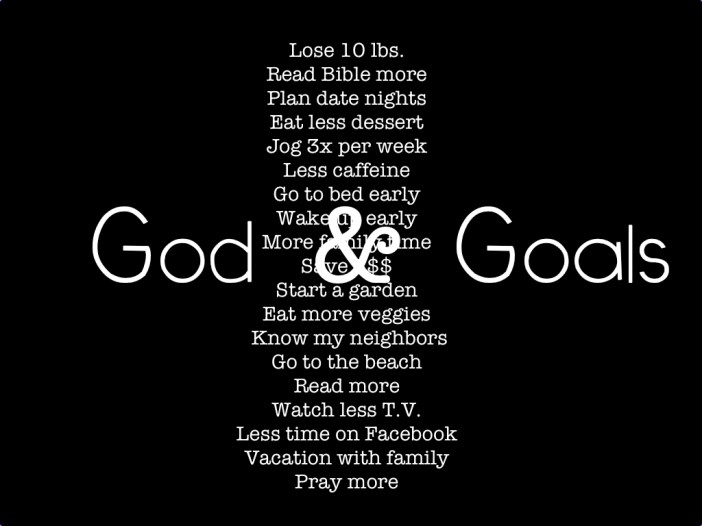
Resolutions: God and Goals

Guest Post by Coty Hoskins

Happy New Years!  You failed again.

Year after year you make resolution after resolution, and if you are like most people you failed to keep the majority of them. Your diet lasted two months, your monthly gym fee was not representative of your attendance, and you almost made it to the Minor Prophets in your Bible reading plan. Why do the majority of people seem to fail their goals every year? And if this is not true of you then maybe you are at the other end of the spectrum—a modern day Pharisee. Because you find worth in your accomplishments, you stop at nothing to keep the resolutions that you have set.

This conversation can quickly become discouraging, even depressing. The purpose in this post is not to discourage; in fact, it is the opposite. I want to think about goals (resolutions) from a Christian perspective. Whether you are a Mr. Fickle or a Mr. Peevish, hopefully you can walk away with two things from this post:  a theological and a practical understanding of goal setting.

Meet Mr. Fickle:
It’s New Years day and he has already thought through his goals for the upcoming year. The irony of his goals is they’re not much different from the years before. The mystery, of course, is whether he will break his record. Will he actually keep one of his goals for more than four months this time? You see, Mr. Fickle doesn’t think much of the goals he sets. In fact, he will soon forget that he even set goals until the smell of cabbage and black-eyed peas fill the room next year

Meet Mr. Peevish:
It’s January 1st and he is sitting at Starbucks. Two refills later and he is still going strong. His pen pours out ink as he charts out timelines for the sub-goals of his goals. Determination drives the movement of his hand as he regrets his imperfections in keeping his goals the previous year. How will he respond this year when one of his goals is slightly held back? Will he despair or explode with anger? You see, Mr. Peevish has a self-worth meter that is determined by his ability to keep his goals.

Who are you? Fickle? Peevish? Both?

For the Christian, goals and God are not mutually exclusive.  God does care whether you fail or not; yet, God does not view you according to your failures.  God does want us to set goals and work hard to meet them; yet, he wants you to find your ultimate worth and identity in the death and resurrection of his Son.  Brothers and sisters, meditate not just on your goals, but how God views your goals.

So then, how are you to think about goals? Mr. Fickle doesn’t get much beyond talking about his goals; Mr. Peevish often spends more time planning rather than doing his goals. I believe there are three important things for both the fickle and peevish to think through. The majority of this section is a summation of C.J. Mahaney’s teaching on roles and goals.

  1. What are my roles?
    To put it simple: there are some things you were created to do, and other things you were not created to do. You must first understand what you were created to do. Start by simply making a list of your different roles in life. Mr. Fickle: you need to write it down.  Mr. Peevish: you need to keep it simple. Here is an example:

    • Child of God
    • Student of…
    • Friend to…
  2. How will I produce my goals?
    Now that you know your specific roles you can begin to set specific goals according to your roles. Mr. Fickle: start out simple; one goal per role is a great start. Mr. Peevish: you need to eventually put your pen down and do something; there is such thing as too much planning.  Here is an example of what your goals may look like:

    • Child of God
      Goal:  Memorize Ephesians 1
    • Student of…
      Goal:  Plan three hours a day to concentrated study.
    • Friend to…
      Goal:  Have coffee with this brother once a month to intentionally encourage him.
  3. How will I prioritize and test my goals?
    You may be surprised at how quickly your list grows. This step is very important unless steps one and two begin to stress you out. First, you must ask:  what are my most important roles?  Second, test your goals. Mr. Fickle: have you put your goals down on paper? Have you thought through practical ways to hold yourself accountable to your goals? Mr. Peevish: are your goals more Christ-centered or man-centered? Have you scheduled more time to do your goals rather than plan them?

Mr. Fickle, let the aroma of beans and cabbage remind you of your goals. Mr. Peevish, enjoy the Verona blend at Starbucks. But this year let your goals be saturated with the thought that God really cares. Go, plan, and do remembering that God wants you to create goals.

Coty Hoskins is a student of Biblical Counseling at Boyce College in Louisville, Kentucky.  He is the Administrative Assistant at Carlisle Avenue Baptist ChurchHe loves traveling, coffee, and spending time with friends. 

The Christian Doubter: God’s Electing Balm

by Spencer Harmon
by Spencer Harmon

The undercutting of your assurance can steal the breath from your lungs.  Terrible thoughts can plague your mind like a migraine that won’t go away.  The guilt mounts; the pressure builds; Satan is whispering lies and telling you that you have never truly believed in Jesus; your faith feels like a twig in a hurricane.  During these dark times a tempting thought to think is, “Why would God save a weak person like me?” Even though God knows everything, your weak faith must be a surprise to him. It may feel that you are giving God more than he bargained for at salvation.  You think that there is nothing in you that would attract God’s salvation.

Here’s the thing:  you’re right.

The church is made up of unimpressive vessels who are conduits of foreign power.  Your twig like faith is not very impressive, but if your twig like faith is rooted in the rock of ages, you will endure the storm.  But why?  Why would God sustain a person who seeks to believe in Him, but yet constantly doubts?

The reason God sustains and saves unimpressive Christian doubters is because He has been planning to do so before the world began.  God has elected you.  He has chosen to save you.  And the most glorious thing about God’s election of weak people like you is that it was not based on your strong faith, your stellar religious resume, or your ability to think positively when things go awry.  Election is based on God’s happy delight in saving people, not on your checklist of strong spiritual moments.  God has already told you this in Ephesians 1:4-5 when he says, “…in love he predestined us for adoption as sons through Jesus Christ, according to the purpose of his will...”  When considering who to save, God did not consider your unbelieving bouts, but rather his sovereign, smiling purpose to show his grace to an undeserving sinner.

So, the next time the tide swells and you’re barely treading water, know that  you will not sink.  God has been planning to set his love on you for ten billion years and more – he will sustain you.    When the wounds of your doubts cut deep, let his divine election is be a healing balm.  Meditate on the truth of God’s unconditional choice of you.  When you are faithless, he remains faithful.  He cannot deny Himself.  Neither death, nor life, nor doubt, or anything in creation can separate you from the love of Christ.

Abortion: The Scarlet Letter of Our Day

by RuthAnne Irvin
by RuthAnne Irvin


You will find it in the fearful and distant eyes of a young girl waiting outside an abortion clinic in the early hours of the morning, smoking a cigarette with no interest in embracing the little life growing within her womb. You’ll see it in the stony eyes and actions of escorts doing what they believe to be their civic duty- protecting a woman’s choice. You will find the sad realities of living in a sin-cursed world everywhere you turn for as long as your lungs continue breathing. Abortion is a controversial topic today and is something that is spoken about in a boisterous manner, or swept under the rug, but still whispered about in the back row of the church as if it were the unforgivable sin.

When thinking about abortion, there has been a disconnect between abortion and the gospel of grace and compassion. Because of our sinful state, we are tempted to place an imaginary scarlet letter upon the issue of abortion, as if it were an unforgivable sin.  A woman who has chosen to end life within her womb instead of embrace it will still answer to God just like the gossiper, adulterer, thief, swindler, & self-righteous Southern Baptist preacher. All will stand before a just God and receive their due for unrepented sin, or a clear record because of placing faith in Jesus Christ’s death and resurrection on the cross.

The truth of Scripture says that every human has fallen below the standard of holiness that God demands in order to commune with him (Romans 3:23). God’s word tells Christians to be holy because he is holy (1 Peter 1:15), but in our humanness we still are prone to sin. All have fallen below the holiness God created us to exude, so we need to give grace to one another like we have been given grace from God through Christ. The gospel has the power to save not only the good, virginal church girl, but the girl with downcast eyes walking into an abortion clinic to end an innocent life.

If we are in Christ, we have been made anew through the blood of Jesus that flows freely to all who repent, believe and call to him for forgiveness. The blood of Christ covers the blood that is on the hands of a woman who has ended a precious life just like it covers the sin of the Women’s Missionary Union president. We need to remember that Jesus’ blood is sufficient for every sin, not just the ones we deem as “acceptable.”

So, when you’re on a sidewalk in front of an abortion clinic on a cold November morning and you watch a mother walk a young girl into an abortion clinic, and as your heart goes from broken to angry, remember Jesus. Remember Jesus and let your heart be filled with compassion for those around you who have not yet experienced the grace of God through the gospel. Let your heart break and remember you are no better than the girl who just walked into the abortion clinic, but you also need a Savior who is willing to take your place for all the wrong you have done. Remember the blood that dripped from the cross covers the angry words said at the breakfast table this morning, as well as the blood that drips from the abortion table. Remember the sin you committed yesterday, this morning and the sin yet to be, and remember that the darkness of sin that dwells within every human soul is what Jesus was nailed upon a tree for.
Remember and let it lead to action. Christ’s followers should be eager to love, care for and counsel those who have had abortions.

The gospel of Jesus is the power to transform hearts and we should desire this transformation for the women who have ended life within their wombs. Remember and then rejoice that you are covered through repentance and remember that the gospel of Jesus Christ is gloriously sufficient for anyone who places their faith in the gospel. Remember and rejoice that we are covered.


RuthAnne Irvin is a student at Boyce College, blogger, and writes as an intern for the Towers Magazine a publication of the Southern Baptist Theological Seminary. You can read more of her writings at her blog Out of the Ordinary Dreamer.


Oxymorons and the Image of God


by Sean Perron


There is absolute truth and it absolutely matters. Christians must love truth because they follow the Truth.
Everything is staked on what we believe.

I want to be the kind of man who lives and dies for the Scriptures. Yet, the great irony is that in my defense of the Bible, I can often sin against others and therefore violate the Bible. If I am not careful, I can treat people of opposing views as completely evil. My view of them becomes one-sided and I only think of them as someone who doesn’t believe [blank].

People are more complex than this and I find myself shocked at times when,

  • I receive a kind note from a pro-abortion friend who asks about my life says they are praying for me.
  • I see a theistic evolutionist who gives sacrificially to the poor.
  • I hear of a universalist who welcomes the broken into their home to minister to them.


Perhaps even reading these lines grates against you. Indeed they should. God wants our doctrine and our lives to match and everyone of the above examples is an oxymoron. These friends claim love Jesus but are believing false teaching.

How should we engage those we strongly disagree with?
I do not have all the answers, but here are some thoughts from the book of James.

1) Be slow to anger (James 1:20)
Be slow to anger, for the anger of man does not produce the righteousness of God. Check your heart.
Jesus remained sinless the entire time he flipped tables and drove out the hypocrites. Do not have as high of expectations for yourself. Often times our righteous anger is self-driven. We are so sinful that we can claim a good cause and spew our venom at the same time. Love is not easily angered. There are times when our blood should boil, but we must have our hand on the stove dial, and there always needs to be love in our burner.

2) Give mercy as you have been given mercy (James 2:13)
For judgement is without mercy to one who has shown no mercy.
If the person you are critiquing believes the true gospel, treat him as you would a brother. We have the right to strongly disagree, but we do not have the right to sin against one another. Give the benefit of the doubt and do not treat a brother or sister like a dirt bag to drag through the mud.

3) Tame the Tongue (James 3:2-10)
With our tongue we bless our Lord and Father, and with it we curse people who are made in the image of God. This ought not be! In our critique, do we show honor to the individual? Or do we curse the ground they walk on?
Do we treat them as people created by God for his glory? Do we give them respect? Or do we treat them like vermin to be exterminated?

4) Love your neighbor as yourself (James 2:8)
Treat others as you would want them to treat you. Be fair in your representation of their arguments. Do not use Ad Hominem arguments that attack them rather than their beliefs. Cultivate a genuine love for them in your heart. Pray for them and long for them to believe truth. “For if you love those who love you, what reward do you have? Do not even tax collectors do the same?”

5) Be confident and calm in Christ (James 3:13-18)
Even though we have the right to bear arms, let us load our arsenal with bullets of truth, love, meekness, and humility.
In our conversations, let us be winsome and confident in the truth. The wisdom that is from above is gentle, open to reason, full of mercy, good fruits, impartial and sincere. Let us display this confidence by maintaining control in the conversation and not yelling at those who disagree. Christ does not need our help in convincing others of the truth. He simply calls us to be faithful to share the truth in love with all meekness.

6) Do not speak evil against one another, brothers (James 4:11)
God does not want us to slander his creation. Let us be careful that we do not sin against God while we represent him to the watching world. Let us be especially careful when we talk about brothers and sisters when they are not around. God hears every word about his craftsmanship and takes it seriously. Even liberals are made in the image of God and we should treat them as such.

7) Bring people back from wandering (James 5:20)
God does not call us to be pacifists when his glory is at stake and souls are on the line. God rejoices when one wandering soul returns to the truth and repents. Let us be people who speak the truth boldly in sincere love.

Blessed are those who proclaim truth to all people and treat them as people made in the image of God.

String Lights and the Law

by Sean Perron

For whoever keeps the whole law but fails in one point has become accountable for all of it. For he who said, “Do not commit adultery”, also said, “Do not murder.” If you do not commit adultery but do murder, you have become a transgressor of the law. James 2:10-11

It might serve us well to meditate on the magnitude of God. His holiness should not be a passing thought or a mere tweet to scroll over. The purity of God deserves more than a polite nod.

James 2:10-11 exposes an uncomfortable reality. If we transgress one law, we are actually guilty for breaking the whole law. If we miss one command, we shame the whole army. If we fumble one ball, we lose the whole game.

How can this be? James says it is because all the commands are traced back to the mouth of God. Every law connects us to the Lawgiver. “For he who said… also said…”

It is similar to decorating tents with string lights, or wrapping an Evergreen with Christmas bulbs. When you finally plug in the lights, ten work and the other thousand refuse to even blink. The entire strand is out simply because one busted bulb has severed the connection.

Each broken law beckons God’s attention. Each sin is a stab at God.
Such an offense against an eternally good God demands damnation.

It might serve us well to pondered the weight of the beams that Jesus took upon his back. The slightest arrogant thought, the faintest lustful fantasy, or the quietest judging critique, all scream “Crucify Him!”  Even the smallest sin demanded that Jesus be pinned to the wood. We need to be staggered by this truth.

Yet, it is gloriously true that even the smallest drop of Jesus’ blood can cover the most hideous act.  The most grievous crime is not too much for the blood of God. Perhaps too strong for the blood of bulls and goats, but not too strong for the veins of Christ.

We need to ponder the severity of sin. The screams of our sin, the weight of the cross, and the blackness of every blunder.

Let us come out from the darkness and into the marvelous light of Christ. Screams of sin are silenced by the nail pierced feet of Christ. Burdens of the law crack with the Words of the God-man. And the blackness of sin is swallowed by a mercy that triumphs over judgement.

Let us come out from under the Law, and come follow Christ.

Adapted from the sermon James 2:10-13: Is the Christian under the Mosaic Law? Delivered at the Sunday Night Bible Study at Crossing Church

Photo by Sam Hearn. Sam Hearn Photography

Babies and Bathwater

by Spencer Harmon

Baptism is a big deal.  When someone becomes a Christian, they are not merely subscribing to a local club that meets on Sundays; rather, a supernatural work of God has taken place.  Christians believe that when someone puts their trust in Jesus their old “self” – with its selfish desires, rebellious disposition toward God, and cold heart – dies, and a new “self” – with a heart inclined to obey God, love his Word, and pursue righteousness – is born.  It is this reality that baptism declares.  Baptism is symbolic – it talks to us and reminds us of these transcendent truths.  It screams out that just as this person is plunged down into these waters that envelop them so their old self has been plunged down into death with Christ; just as they rise out of the water and gasp for air, so their new self has arisen with Christ.

For Protestant Christians, there have been two views as to who should be baptized:  1) those who have professed faith in Christ (credo baptists); and 2) those who have professed faith in Christ and their children (paedo baptists).  I’m a credo baptist.  I don’t think you should baptize babies.

One of the strongest arguments for believer’s baptism can be made from an Old Testament passage:  Jeremiah 31:31-34.  It is here that God Himself delineates through His prophet Jeremiah his “new covenant”  This is God’s new agreement with his people that binds him to treat them in a certain way so long as they keep their end of the bargain.  However, the problem with God’s people over history is that they have never been able to keep their end of the bargain.  They always worship the idol; they always complain in the desert.  But God has a plan – a new covenant.  The newness of this covenant is found in that fact that God promises to give his people a heart that actually wants to keep the law (verse 33).  God promises that everyone will know him in a saving way, and that all of their sins will be forgiven.  God says that this new covenant will not be like “the covenant that I made with [your] fathers” (verse 32).  The newness of the new covenant is found in the fundamental difference between the people of God before and after the coming of Jesus.  Before Christ, the covenant members were those who were born into the people of God – this means that there where people who really loved God in the community, and those that just were among the group, but did not really know the Lord.  After Christ, God’s covenant members are only those who have been regenerated (i.e. given a new heart that truly loves God).

If Jeremiah is interpreted as an announcement of a regenerated covenant community, those who support baptizing infants need to reconsider their view.  For if the covenant community is only those who have been regenerated, then it follows that the mark of the covenant community – baptism – should be limited to this specific group of people.  The new covenant has a new sign and it is reserved for people who have new hearts.

Some Practical Concerns

  1.   It seems inconsistent for a paedo baptist not to include infants in the Lord’s Supper.  If they are seeking to emphasize the continuity of God’s dealings with his people in one overarching covenant, it would seem consistent to include the children of the God’s people in this rite as well.  However, this would pose problems.  First, if children participate in the Lord’s Supper, it seems like this would say something that is not true.  When I take the Lord’s Supper, my pastors say to me, “Spencer, this is the body of Christ broken for you; This is the blood of Christ poured out for you”  But we can’t honestly say this to babies until they make a profession of faith.  Second, babies are incapable of examining their conscience, or confessing sin (one of the things baptism should push a believer towards), so why should they participate in the Lord’s Supper?  Yet infant baptism seems to lead to this.
  2.   Another concern is that church discipline seems to lose its relevance.  If children are included in the people of God by baptism, how do you determine if they are ever not a part of the true covenant community?  If the church is constantly a mixed community of both believers and unbelievers, why would any church discipline a non-Christian from their midst if it has embraced a mixed church?  Some may object that if a paedo baptist church knew that there was an unbeliever in their midst, they would most certainly discipline them.  Yet, for every baby that is baptized, an unbeliever is added to their community.  Why the inconsistency in church discipline?

Conclusion

Baptism is a secondary issue, but not a small issue.  Baptism is the sign of salvation, and how the church understands this sign of salvation matter immensely.  To misunderstand the issue of baptism is to run the risk of false assurance to those baptized as children, and a distortion of a beautiful portrayal of salvation.  Although evangelical Christians ought to keep the main thing the main thing, we ought to openly acknowledge our disagreements over these important issues.  So, let there continue to be conferences; let pastors be together for the gospel, and let evangelicals make coalitions; nevertheless, let there be an open and plain acknowledgement of these distinctive beliefs that make whole denominations form.  For these issues are exceptionally important, and ought to be treated like it.  So, keep the baby, but throw out the bathwater.


Prediction vs. Prayer: Christian Responsibility in the Presidential Election

by Heath Lambert

During this election cycle just reading the headlines will make you lose your mind.  A short week and a half ago, headlines warned: Romney is Running out of Choices and Time, Romney Desperate in Search of Votes, It’s Over—President Obama Will Be Reelected.  One debate later the headlines are very different, even opposite: Romney Opens Cracks in Obama’s Firewall, Obama’s Aides Plot Comeback, Obama’s Dilemma—How to Reset the Race.

I get it.  This is high-stakes political theater.  A lot of people are paying attention and everyone would like to be the person who correctly guesses the outcome of the election.  The operative word, however, is guess.  Nobody knows what is going to happen on November 6th.  As Christians we know that God alone knows the future.  The prophet Isaiah links God’s glory with his ability to declare the future when he says,

I am the Lord; that is my name; my glory I give to no other, nor my praise to carved idols. Behold, the former things have come to pass, and new things I now declare; before they spring forth I tell you of them. (Isaiah 42:8-9)

God will not give his glory of authoritatively declaring the future to another.  God enjoys displaying his glory in being the only one who knows for sure what happens next.

That is why the story of presidential elections (and everything else for that matter) is the story of surprises.  There are surprises in every presidential election in the last century.  Sometimes those surprises are huge in magnitude (President Truman’s defeat of Thomas Dewey in 1948).  Sometimes those surprises are of a smaller sort (Al Gore lost his home state of Tennessee to George W. Bush in 2000).  The same will hold true this year.  There is a vice-presidential debate tonight, and then two more presidential debates in the weeks to follow.  The election narrative will reset after each of those events.  Then, when we wake up on November 7th, all of us will be puzzling over different things.

That means Christians should not waste their time playing the pagan game of guessing the future when it comes to elections.  Instead of guessing Christians should be using their time doing three much more important things: praying, pondering, and persuading.

First, we have a command that we are to pray for “Kings and all who are in high positions” (1 Tim 2:2).  That means we should be praying for Mitt Romney and Barack Obama.  One of them will be our president for the next four years and they need grace to be wise, strong, and full of integrity.  Instead of guessing about the election we should be praying for it.

Second, we need to ponder the many different issues at stake in this election.  There is no shortage of crucial issues to consider—abortion, tax policy, religious liberty, international affairs, and many others. Some Christians think we shouldn’t vote because Romney is a Mormon or because the candidates are not that different.  Many Believers think that Romney should be elected because he is the best to defend the moral issues Christians care about.  Some argue Obama would be a better defender on social justice issues.  The point is that all these things are worth pondering.  Thinking about such matters (and praying for them) is infinitely more profitable then chewing your nails trying to figure out what will happen on election day.

Finally, after we have prayed about the issues, and pondered them, we need to try and persuade others.  As Christians we should use our conversations, tweets, blogs, and news stories to contend for the candidate we believe is the most suitable to hold an office as significant as president of the United States.  For my money, Christians will make an egregious error if they abstain from voting or vote for any candidate who is openly in favor of killing innocent human beings.

I’m sure there are some who are offended by that  or who disagree with me.  That’s fine. Let’s talk about it.  That is a conversation that will matter.

When we have it at least we won’t be wasting one-another’s time playing
God and hazarding guesses.

Heath Lambert is the Executive Director Elect of the National Association of Nouthetic Counselors and the assistant Professor of Biblical Counseling at Boyce College; He is also the author of Biblical Counseling After Adams and co-author of Counseling the Hard Cases.

No Valor

by Sean Perron

I am earnestly concerned about the slow cooking idea that is beginning to circulate among evangelicals regarding this year’s election. I recently read an article about pastors encouraging their congregations not to vote this year. They are arguing that Christian voters have no other option except to either stay at home or vote for a third party. They say we can’t vote for someone who promotes gay marriage nor should we vote for someone who follows Joseph Smith. Beware little flock! Beware of the planet owners. Stay inside this November…

But should Christians follow this advice?

I openly confess that I am writing with an agenda. I propose that if you do not vote this election year, you will be unfaithful to your duty as a Christian citizen, a failure as a clear thinking individual, and will be responsible contributing to a mindset that fuels immorality and wickedness.

The idea that Christians should avoid the polls this year because of their religious beliefs is a disgrace that is blinded by misguided conviction. This trumpet is blown by pastors who think they are calling their brothers and sisters to victory but are actually calling them to retreat while thousands are being killed on the battlefield. If you are an evangelical considering staying at home this election season, please consider the following points:

1) There will always be beliefs a presidential candidate holds that we will disagree with.

It should be our prayer that every president would believe in the good news of Jesus’ life, death, and resurrection. I wish every presidential candidate would turn from their sin and seek the kind face of God. But Eden is gone and along with it went the perfect president. If we are honest, every presidential candidate will believe, do, and promote things that we disagree with. Yet we can rally behind a candidate with our vote even if he falls drastically short of the ideal.
Christians are in the world and Jesus calls us to continue to remain in the world and help change it. But you and I can’t change an election by remaining on our couch, even if the cushions are stuffed with conviction.

2) There are more important issues at stake than baptism of the dead

I fully agree that Mormonism is wrong and leading many people away from the one true and living God. However, I am not baptizing the dead but I am trying to save the living. It is no secret that Barack Obama promotes abortion. It is also known that Mitt Romney is not fully pro life. He believes abortion in the instances of rape is permissible. He does not hold the Biblical position. But it is clear that Mitt Romney opposes Roe vs. Wade. It will only take one more pro-life supreme Court justice to turn the tide against abortion. The next president doesn’t determine everything about this issue but may have the opportunity to appoint new justices. This alone should awaken a flame in us to care about voting. This year you are given the option to help save lives and promote the sanctity of life. 5,000 abortions is better than 5 million abortions.

3) Not voting is voting

Last month, a famous pastor tweeted, “Been told not voting for Romney is a vote for Obama. That’s alright since that must mean not voting for Obama is a vote for Romney.”

While this is a cute quip, it makes a poor math equation.  Let me attempt to write on the chalkboard:

  • If Dick votes for Obama, and Jane does not vote, then the tally is 1 to 0.
  • If Dick votes for Obama, and Jane votes for Romney, then the tally is 1 to 1.
  • If Dick and Jane vote for Obama while Spot stays in the dog house, then the tally is 2 to 0.
  • See Obama win, watch Romney lose.

Or, for those who favor a third party, if Dick brings all of his friends to vote for Obama and Jane and all of her friends vote for Ralph, then the tally is 1,000,000 to 300.

Although we may wish it were not true, to vote for a third party has the same outcome as not voting. While it may sound reformational to write-in a ballet and say, “I’m voting my convictions”, it is actually the equivalent to firing a blank. It makes a loud noise and produces nothing. You win the battle of conviction but lose the war of reality. Christians cannot afford to pittel away their vote this year. We are people who redeem the time because Christ is drawing near.

4) You are responsible for your vote or lack thereof

If Christians do not vote, someone else will, and they might vote for killing babies or marrying homosexuals.  There are many issues at hand such as: abortion, big government, bankrupting health care, international relations and military disarmament. And like it or not, you and I are responsible for what we say or do not say.

The Christian voter who stays at home should be ashamed that he did not consider all the issues at hand and stand for what they could. God has given the American Christians a simple opportunity to impact their country. To neglect this blessing is  to insult God. If you have the God-given opportunity to vote for babies to have a chance at life, and instead you neglect that because you disagree with a man’s view of the Trinity, you are the most pitied of all men.

I fully heartily agree with the recent article Denny Burk wrote in the SBTS Towers,

“At the last judgement you will not be able to claim ignorance about your duty to defend innocent human life. Remember, more than 50 million innocent human lives have been snuffed out legally since 1973. If somehow you were unaware of this fact before reading this essay, you now know better. You are accountable for this knowledge, and your vote should reflect it.”

5) Consider Courage

If you will allow me to take it up a notch, we finally must consider courage.

Do you think it is brave to “no show” when thousands of soldiers have given their lives to make the polls available to us?  They were valiant to give everything for the freedom we are taking advantage of.  Yes, because of their valor we are free to sit on our rumps. But I cannot.  And if you sit, you must know that there is no courage in making the election a spectatorial event. There is no impact. There is no boldness. There is only shame. There is no valor in not voting.